A video about the phases of mitosis. It might seem long and boring, but hey, he's indian, im pretty sure he knows what he's talking about
Showing posts with label Cells. Show all posts
Showing posts with label Cells. Show all posts
Monday, October 17, 2011

Cell Cycle Extra Credit!
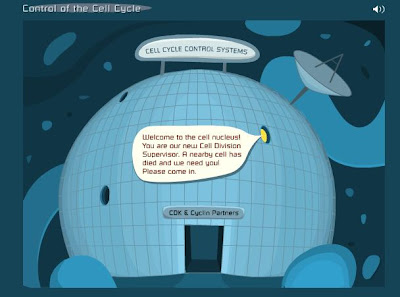
Hey Guys... this is a REALLY fun game about the cell cycle... I hope you enjoy it! Click on this link to play it. WHO is the "Cell Division Supervisor" who is controlling everything in the game? First 3 people to EMAIL me the answer will get EXTRA CREDIT! Enjoy!
stuck in the mud
I feel pretty good about this section but the one thing i don't understand is if each individual cell has a different pace at which it reproduces or if the same type of cells all reproduce at the same rate
Saturday, October 15, 2011
Muddiest point
My muddiest point for this unit is memorizing what happens in the cell cycle. I know what happens during interface, but no visually. This is the same with mitosis.
Friday, October 14, 2011
Point Of Muddiness!!!!!
Hiiiiaaaa!!!! It's SarahL!!!! YAY so my muddiest point is that i'm confused with the difference between G1 phase and S-phase it's hard!!!! HELP MEEEE! thanks ya'll!!!
MUDDIEST POINT!?!? NOT AGAIN!
Hey it's jon, and my muddiest point is that it is really hard for me to memorize all the different organelles of all the different cells there are!! NEED HELP PLEASE!
DID YOU SAY MUDDIEST POINT!?
Hey Period 8! Rachie here :) I think my muddiest point this unit was naming the orangelles that the plant cells had and the animals didn't, and vice-versa. HELP!
MUDDIEST POINTT!!!
Hai guyss!! Its HEIDI!
My what muddiest point is........what specific things happen in each phase in mitosis & how they are supposed to look like.
Mie schmutig punkt! :)
Hey guys!! If you didn't know the title is "my muddiest point" in German! Haha! But alright so I am confused on what helps during cell division, and what organelle converts energy from sunlight into chemical energy! Help! Thanks!!
Thursday, October 13, 2011
The phases of the cell, say what?!
Why hello there, Anka here! My muddiest point is the difference between each CELL PHASE. What is one characteristic of each phase that distinguishes them from the others? Thanks a lot guys! (:
MUDDIE POINT
hey its kelly
so my muddiest point from the unit was knowing the difference between the rough & smooth ER & what their functions are
muddiest point
hiii its eleni and so far im really confused with all the different phases. i get that there is a bunch of different ones during mitosis but then there others outside of mitosis and i don't get what all those ones are/do. i know this is kinda general but if you can help me that'd be great!!!
Wednesday, October 12, 2011
MITOSIS

HI guys! It's Heidi!!
We also talked about our CANCER PROJECT, and what the difference between BIBLIOGRAPHY (a separate sheet of paper w/alphabetized sources) & CITATIONS AND APPROPRIATE USE OF RESOURCES (in parenthesis within the text itself) are.
So, today we had a little activity that had to do w/MITOSIS, which is the division of cells, were we had little cut out squares of the steps in MITOSIS, and had to put it in order from the 1st step of MITOSIS to the last.

HERE'S A VIDEO ABOUT MITOSIS THAT WILL HELP YOU
UNDERSTAND MORE ABOUT IT ----->
We also talked about our CANCER PROJECT, and what the difference between BIBLIOGRAPHY (a separate sheet of paper w/alphabetized sources) & CITATIONS AND APPROPRIATE USE OF RESOURCES (in parenthesis within the text itself) are.
CANCER PROJECT IS DUE ONE 10/25/11.
*REMEMBER TO DOUBLE SPACE & NOT TO LIST THINGS!!!
Mrs. Stein talked about https://turnitin.com/static/index.php as well and how to create our student account, which is due on FRIDAY!!!!
THE NEXT SCRIBE IS............EUNICE LEE!!! :D
Monday, October 10, 2011
OSMOSIS
Hey guys its kelly
so today in class we reviewed the plasmolyzed cells lab & the enzyme lab
we also talked about OSMOSIS which is the process in which water DIFFUSES through a semi permeable membrane & how things go from high to low
then we went to the library to take surveys for our risks at getting certain types of cancer(which we had to finish for homework)
the next scribe is HeidiH
Enzymesss!!!!!!!!!!!!!!!

Hey ya'll it's Sarah L here with your newest scribe post!!!! YAY!!!
So in our wonderful biology class today we did a.... LAB!!!! It was sooo much fun and very cool to watch!.
In our procedure we first started to heat water to the decided temperature for you group (my group was 100). Then we marked twon lines one for the catalase (which is an enzyme that speeds up the process of chemical reactions!!! Ooo Ahhh

When we were done setting up it was time for the dirty work... So we filled the catalase to the first line of the test tube and we placed it in our water at the correct temperature of course, then waited ten minutes for results.
After ten minutes we checked the temperature to record it, then we took the tube out and put hydrogen peroxide into the tube to the second line. Then, we waited twenty seconds for results and we recorded the bubble height.
In the end, most of the bubble columns got to four to seven centimeters except the temperature of 100 degrees celcius. Also. the average temperature for all of them was twenty degrees celcius to fourty degrees celcius.

Thursday, October 6, 2011
Busy Day!

Hey, Anka here! Today was a busy day in biology class!
For starters we learned about catalysts. A Catalyst is a substance that speeds up a chemical reaction because it decreases the amount of energy a cell needs to use during a chemical reaction.
To demonstrate the effect of a catalyst
during chemical reaction, our teacher poured a small amount of hydrogen peroxide into a graduated cylinder. Hydrogen peroxide is known to turn into water after a certain amount of time. Well, to speed up the process, a catalyst solution was added to the hydrogen peroxide. Adding the catalyst caused a crazy reaction that made the hyrdrogen peroxide bubble up. The catalyst was speeding up the transformation of hydrogen peroxide into water! Cool, right?!
After learning about catalysts, we conducted a lab comparing normal and plasmolyzed cells. A cell is plasmolyzed when a plant cells protoplast is forced to shrink due to water loss.
- To begin the experiment, we prepared a wet mount with 3 drops of TAP water and added one elodea leaf to the water. Then, we wait 3 minutes. After 3 minutes,
 we observed the leaf under low and high power on a microscope. We then picked one particular cell to observe. The cell was green and contained a cell wall and chloroplasts. We noted that the chloroplasts were randomlyspaced out, as you can see in the picture to the right.
 - Next we prepared a wet mount with 3 drops of SALT water and added one elodea leaf to the water. After 3 minutes of waiting, we picked one single cell and observed it under high and low power. The cell was also green and contained a cell wall and chloroplasts. HOWEVER, the chloroplasts were sort of clumped together in the center of the cell.

This was caused by osmosis. Osmosis is when areas of high water concentration move to areas of low concentration. This happened because if you apply salt water to an elodea leaf the
balance of the water outside the cell and inside the cell is changed. The addition of salt to water causes the water concentration to diminish but the salt to increase. In other words, more water molecules were leaving the cell rather than going into the cell and more salt molecules were going into the cell. This caused chloroplasts to clump together, which means this cell was plasmolyzed. This is why plasmolyzed cells are different from normal cells.
And that's basically what we did in class today! The next scribe will be Sarah! (:
Tuesday, October 4, 2011
CELLS CELLS CELLS

De hello everyone, its Lucas,
yesterday in class we learned about cells and their parts. More specifically we learned how each thing was used in the cell. we learned the difference between plant and animal cells also.one of the main differences plant cells have a wall on top of the cell membrane as with animals , they only have a cell membrane. the reason they have this wall is because it is used in the reproductive process that is much different from the animal cells reproductive process. we also took a quiz. this quiz had a very interesting way of asking what each cell did. the quiz had you correlate between a real life situation, such as a cake shop, and how a cell's inter workings do specific things that help the cell achieve a specific task. each type of plant or animal cell has a specific role that it does to help the organism that it makes up survive.
so goodbye everyone (^.^)
The next scribe is HENDERSON! (MikeH)
Wednesday, September 28, 2011
CELLS
Hey it's Jonathan and today in class we started taking about what cells are, what is their job in life, and what are some different types of cells. The definition of cell are the basic units of life. Which means without cells an organism can't live. Some different types of cells that exist are Prokaryote, Eukaryote, Plant, and Animal cells. A Prokaryotes are types of cells that do not enclose DNA in nuclei. Instead of keeping their information in the nuclei, they keep it in the DNA chromosomes. Eukaryote is a type of cell that encloses its DNA in the nuclei. During the last 15 min of class we shared are facts that we came up with about the cells. And sorry bout not having a picture up because I was having trouble getting on the post.
Next Scribe is Mark
Next Scribe is Mark
Subscribe to:
Posts (Atom)